From Typwriters to AI:

Shelah Johnson
Co-founder / Producer . Riveter Studio
16 min read
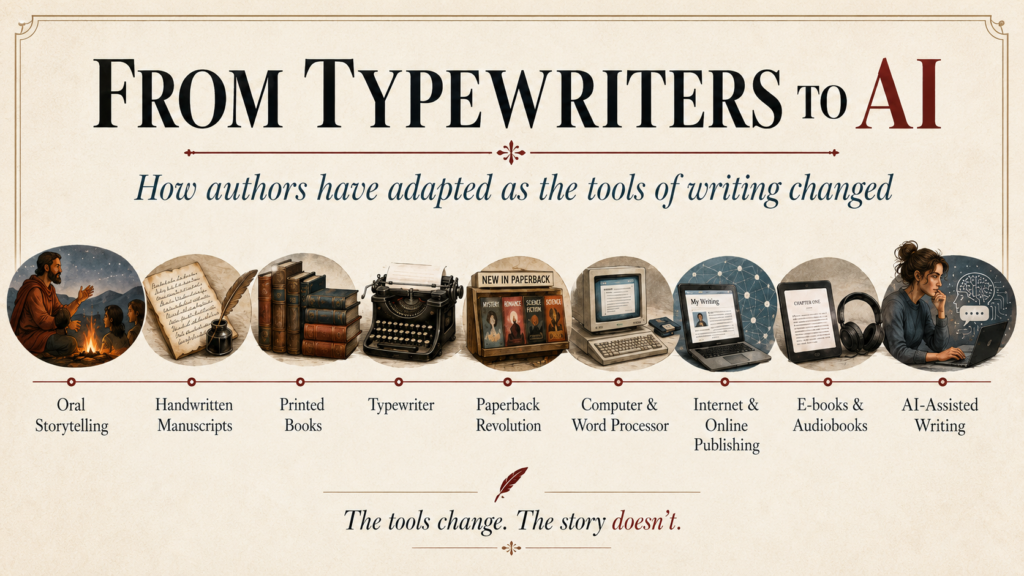
The tools keep changing, but real work remains the same: getting the story from one human being to another.
There’s a romantic lie that gets handed to writers in every generation.
It says the “real” author works outside of time. The real writer sits alone with a fountain pen, a stack of paper, and some noble suffering. The real book is discovered because it is good. The real artist doesn’t need platforms, algorithms, microphones, cameras, websites, newsletters, editing software, book trailers, interviews, or social media.
It’s a beautiful lie.
But it’s still a lie.
Authors have always worked inside the machinery of their time. They have always had to respond to new tools, new audiences, new gatekeepers, new business models, new moral codes, and new definitions of what “serious” work is supposed to look like.
A story does not move through the world by magic. It moves through formats. It moves through technology. It moves through whatever delivery system exists at the time.
A story does not move through the world by magic. It moves through formats.
The oral tale became the manuscript. The manuscript became the printed book. The printed book became the paperback, the audiobook, the e-book, the blog post, the newsletter, the podcast, the author interview, the searchable archive, the recommendation engine, the social clip someone sends to a friend because something in it hit them at the right moment.
The author’s job has never been only to write the thing.
The author’s job has also been to understand how the thing reaches people.
That second part is the one nobody wants to talk about. It feels less pure. Less noble. Less literary. But it has always been part of the work.
Over the last hundred years or so, writers have had to adapt again and again. Some resisted. Some adapted badly. Some adapted brilliantly. Some built entire careers because they understood the new machinery before everyone else did.
And every time, somebody declared the new tool would cheapen the art.
The typewriter would make writing mechanical. Paperbacks would cheapen books. Genre fiction would rot the culture. Computers would make writing soulless. The internet would destroy attention spans. E-books would kill bookstores. Social media would turn authors into brands. AI would end creativity.
Some of those fears were not stupid. Every new tool brings real losses. Craft gets flattened. Markets get flooded. Bad work travels faster. Middlemen reappear wearing new clothes. Writers get pressured to become marketers, performers, analysts, content machines, and sometimes their own unpaid publicity departments.
But the larger pattern is hard to ignore: the authors who survive are rarely the ones who pretend the clock stopped.
They are the ones who learn what changed, keep what matters, and adjust the delivery without surrendering the soul.
The Typewriter and the Fear of Mechanical Writing
Before the computer changed writing, the typewriter did.
It’s hard to feel that now because the typewriter has been absorbed into nostalgia. We see one and think of literary seriousness: the clack of keys, the ink ribbon, the cigarette smoke, the stack of pages. But when the typewriter became a working tool, it changed the physical relationship between writer and page.
Writing by hand is intimate. Slow. Bodily. The hand moves at the pace of thought, or maybe thought moves at the pace of the hand. The typewriter put a machine between the writer and the words. It standardized the page. It made manuscripts more legible to editors and publishers. It made revision visible and sometimes ugly. It also made writing faster.
That speed mattered.
For journalists, playwrights, pulp writers, screenwriters, magazine writers, and commercial novelists, the typewriter was not a quaint object. It was production equipment. It helped writers meet deadlines. It helped newspapers move copy. It helped publishing houses process manuscripts. It helped writing become part of a faster, more standardized literary pipeline.
And yes, it changed the prose.
When tools change rhythm, they change style. A sentence that arrives through a pen is not always the same sentence that arrives through keys. The typewriter encouraged a different kind of momentum. It made drafts feel more provisional. It helped normalize revision as a typed process rather than a handwritten ordeal.
It also made the writer look, in some ways, more like a worker inside an industrial system.
That was the discomfort.
The typewriter made writing feel less mystical and more manufactured.
The typewriter made writing feel less mystical and more manufactured.
But it did not kill literature. It did not kill voice. It did not kill style. Writers folded it into the work. Eventually, the once-suspicious machine became part of the room.
That pattern would repeat again and again.
A tool arrives. Writers panic. The serious ones test it. The hacks exploit it. The industry absorbs it. The craft changes. Then the next generation treats the once-feared machine as sacred.
Paperbacks, Pulp, and the Fight Over Respectability
Technology does not always look like a machine. Sometimes the format is the revolution.
The rise of mass-market paperbacks changed how books moved through the world. Books became cheaper, more portable, and more accessible. They could be sold in train stations, drugstores, newsstands, supermarkets, and bus depots. They could live outside the formal dignity of hardcover publishing.
Naturally, people panicked.
Cheap books were associated with cheap culture. Genre fiction, crime novels, romance, westerns, science fiction, horror, and adventure stories all carried the stain of being “lesser” forms at one point or another. Not because readers did not love them. Readers absolutely loved them.
That was part of the problem.
Popularity has always made certain cultural gatekeepers suspicious.
The paperback did something dangerous: it put stories directly into more hands.
That changed authorship. It changed pacing. It changed cover art. It changed genre expectations. It changed the economics of writing. It created room for fast production, series characters, recurring worlds, and commercial storytelling on a scale that earlier literary systems did not support as easily.
Was a lot of it formulaic? Of course.
But formula is not automatically failure. Sometimes formula is a container. Sometimes it is a promise to the reader. Sometimes it is the thing that lets a writer smuggle in class anxiety, gender politics, grief, violence, longing, and social change under the cover of entertainment.
A mystery novel can be about justice. A romance can be about power. A western can be about land, violence, masculinity, and myth. A horror novel can say more about a culture’s fears than a shelf full of polite realism.
The mistake is assuming that accessibility means shallowness.
The mistake is assuming that accessibility means shallowness.
Respectability often arrives late.
The work comes first.
The Computer and the End of the Sacred Draft
Then came the computer.
For writers, the computer did not just replace the typewriter. It changed revision.
On a typewriter, revision has weight. Rewriting a page means retyping it. Moving a paragraph is labor. Structural changes require patience and sometimes scissors, tape, or an iron stomach. The draft resists you.
On a computer, the draft becomes fluid. Sentences move. Paragraphs disappear. Chapters can be rearranged. Versions multiply. The page is no longer a fixed object. It is a living surface.
That freedom is powerful.
It is also dangerous.
The computer makes it easier to revise. It also makes it easier to never finish. A writer can polish the same paragraph into dust. A chapter can be moved so many times the book loses its spine. A manuscript can stay alive forever, which is another way of saying it can refuse to become done.
Digital tools remove friction, and some friction is useful. Friction forces decisions. It forces the writer to ask whether the change is worth the trouble. It creates a cost.
But the computer also opened doors. It made drafting faster. It made long projects more manageable. It helped writers organize research, track versions, search their own manuscripts, submit electronically, collaborate with editors, and recover work that might once have been lost to a single damaged page or misplaced folder.
It changed who could write seriously, too.
A writer with a laptop no longer needed a perfect office, a dedicated typing room, or access to expensive clerical support. A writer could work at a kitchen table, in a library, on a lunch break, or between jobs. The machinery of production got smaller and cheaper.
That mattered.
Access always changes the room. More people enter. More work gets made. Some of it is bad. Some of it is brilliant. Some of it never would have existed under the old system.
The gate opens. The room fills. The old hierarchy complains.
Some of the complaints are valid. A flooded market is difficult. But difficulty is not an argument for going backward.
The Internet and the Collapse of Distance
The internet changed everything because it collapsed distance.
For authors, it became possible to reach readers without waiting for a publisher, reviewer, bookstore buyer, newspaper column, or conference invitation to grant permission. Websites, blogs, online magazines, forums, newsletters, fan communities, digital bookstores, and later social platforms created new paths between writer and audience.
That was liberating.
It was also exhausting.
The internet did not remove gatekeepers. It multiplied them.
The internet did not remove gatekeepers. It multiplied them.
Search engines became gatekeepers. Platforms became gatekeepers. Algorithms became gatekeepers. Metrics became gatekeepers. Online retailers became gatekeepers. Audience behavior became visible, trackable, and monetizable. Writers were told they could reach everyone, then discovered that reaching anyone required constant feeding of systems they did not control.
This is where a lot of authors began to burn out.
The internet gave writers tools their predecessors could only dream of. It also quietly added new jobs to the creative life.
Now the author was not only an author. The author was a brand manager, newsletter writer, content strategist, event promoter, metadata checker, website maintainer, community manager, analytics reader, and sometimes reluctant video personality.
A lot of writers hate this.
Fair enough.
But hating it does not make it untrue.
The modern creative economy rewards visibility. That does not mean every author has to dance for the algorithm. It does not mean every novelist has to become a motivational speaker on TikTok. It does not mean every poet needs a funnel.
But it does mean writers need some understanding of how discovery works now.
Otherwise, they are leaving the fate of their work entirely in the hands of systems that do not care about the work.
E-books, Audiobooks, and the Book That Wouldn’t Stay Still
The book used to be easier to define.
Not better. Easier.
A book was a physical object. It had weight. It had a cover, pages, a spine, a smell, a place on the shelf. You could hand it to someone. You could mark it up. You could lose it in a suitcase. You could see your life in the creases.
Then the book became digital.
E-books changed the idea of ownership, access, pricing, and distribution. They made it possible to carry a library in a bag. They made self-publishing more viable. They gave backlist titles new life. They let readers adjust type size, search text, and buy a book at two in the morning without leaving bed.
They also made books feel less fixed. Less visible. Easier to ignore. Easier to discount.
The e-book did not kill the printed book, despite years of panic. But it did change reader expectations. It changed speed. It changed price sensitivity. It changed the relationship between author, publisher, retailer, and reader.
Audiobooks changed the room again.
In one sense, audiobooks brought literature back toward its oldest form: the spoken story. In another sense, they created an entirely different reading experience. A narrator’s voice can deepen a book, flatten it, complicate it, or rescue it. A commute can become reading time. A walk can become a chapter. A reader who struggles with print can still enter the story.
That matters.
The book did not stop being a book because it left the page.
It became another doorway.
Norms Changed Too
Technology is only half the story.
Over the last century, writers have also had to adapt to changing norms around race, gender, sexuality, class, violence, authorship, consent, labor, ownership, and representation.
Some of this change has made the work better. Stories that were excluded, mocked, stereotyped, or suppressed have moved closer to the center. Readers ask harder questions now. Who gets to tell the story? Who benefits? Who is flattened? Who is missing? Who has been turned into scenery?
These questions can be uncomfortable. They can also be useful.
But there is another side. Writers now work in a climate of instant reaction. A sentence can become a screenshot. A character’s flaw can be mistaken for the author’s endorsement. Ambiguity can be treated as a failure of messaging. A book can be judged by people who have not read it and never planned to.
That creates fear.
Fear creates bland work.
The answer is not to go backward into lazy cruelty or careless stereotypes. The answer is also not to make every novel behave like a press release.
Writers have to become more precise.
Precision is different from obedience.
A serious author can absorb changing norms without surrendering complexity. A serious author can write flawed characters without asking the reader to admire them. A serious author can depict harm without making harm decorative. A serious storyteller can engage the present moment without turning every scene into a lecture.
The times change.
The work has to get sharper.
AI and the Current Panic
Now we are in the middle of another shift, and this one feels especially volatile because it touches the sacred center of creative identity.
Artificial intelligence has forced writers, editors, designers, illustrators, narrators, and publishers to ask frightening questions. What is human authorship worth? What happens when machines can imitate style? What happens when production gets faster than judgment? What happens when the market is flooded not just with amateur work, but with synthetic work at scale?
These are not imaginary concerns.
Writers are right to be protective. Labor matters. Consent matters. Credit matters. Copyright matters. The difference between assistance and replacement matters. A company using technology to avoid paying artists is not innovation. It is exploitation with better software.
A company using technology to avoid paying artists is not innovation. It is exploitation with better software.
But it is also too simple to say every new tool is the enemy of art.
The better question is this: does the technology deepen human intention, or does it erase it?
That question applies to everything. Typewriters. Computers. Templates. Editing software. Audiobook tools. Distribution platforms. AI.
A human-led process still matters. Taste still matters. Judgment still matters. Lived experience still matters. The ache behind a story still matters. The ability to know why a chapter works, where it turns, what it costs, and what it leaves behind — that is not a button.
The danger is not that writers will use tools.
Writers have always used tools.
The danger is that industries will use tools to pretend writers are unnecessary.
That is where the fight is.
What Carries Forward
Look back across the last hundred years and the pattern becomes almost boring in its consistency.
A new tool appears. The old guard distrusts it. Early adopters overuse it. The market gets noisy. Standards wobble. Some writers lose ground. Some new writers enter. Eventually, the tool becomes normal. Then everyone starts romanticizing the thing it replaced.
Nobody wants to admit how often yesterday’s “authentic” art was once accused of being fake, cheap, mechanical, commercial, unserious, or dangerous.
The question for authors is not whether change is coming.
It already came. It keeps coming.
The question is what to carry forward.
Because not everything should be preserved. Some traditions were just bottlenecks. Some standards were just snobbery. Some gates existed to keep the wrong people out. Some definitions of quality were built around who had access to money, time, education, equipment, and permission.
But not everything new is progress either.
Speed is not depth. Reach is not resonance. Visibility is not meaning.
Speed is not depth. Reach is not resonance. Visibility is not meaning. Automation is not imagination. A platform is not a community. A trend is not a voice.
Authors have to be stubborn about the right things.
Be stubborn about story. Be stubborn about craft. Be stubborn about emotional truth. Be stubborn about credit. Be stubborn about ownership. Be stubborn about the human pulse inside the work.
Be flexible about the delivery system.
That is not selling out.
That is staying alive.
For authors, this means understanding that the book is no longer the only object in motion. The book may still be the center, but the story around the book matters too: the author’s voice, the origin of the work, the excerpt that can stand alone, the interview that lets readers feel the person behind the page, the visual language that helps the story travel.
That is not a lowering of standards.
It is an expansion of pathways.
The writers who resent every new pathway may still make good work. But they may also find themselves shouting into a room that no longer exists.
The writers who chase every new tool without discipline may get attention. But attention burns fast when there is no substance underneath it.
The real work is harder.
Learn the tool. Question the tool. Use the tool. Refuse to be used by the tool.
Authors have been doing this for a century, whether they called it adaptation or not. They adapted to machines, formats, markets, audiences, norms, and entire systems of discovery. Some changes were brutal. Some were liberating. Most were both.
And still, the work continued.
People kept publishing poems.
People kept telling stories.
People kept finding ways to get the story from one human being to another.
That is the part worth remembering.
The tools change. The rooms change. The business changes. The audience changes. The rules change, then change again.
But the need underneath it all has not gone anywhere.
Someone has something to say.
Someone else needs to hear it.
Everything in between is technology.
Stay in the loop
New essays, author stories, and craft insights — straight to your inbox.