Getting Above the Noise Isn’t About Being Louder

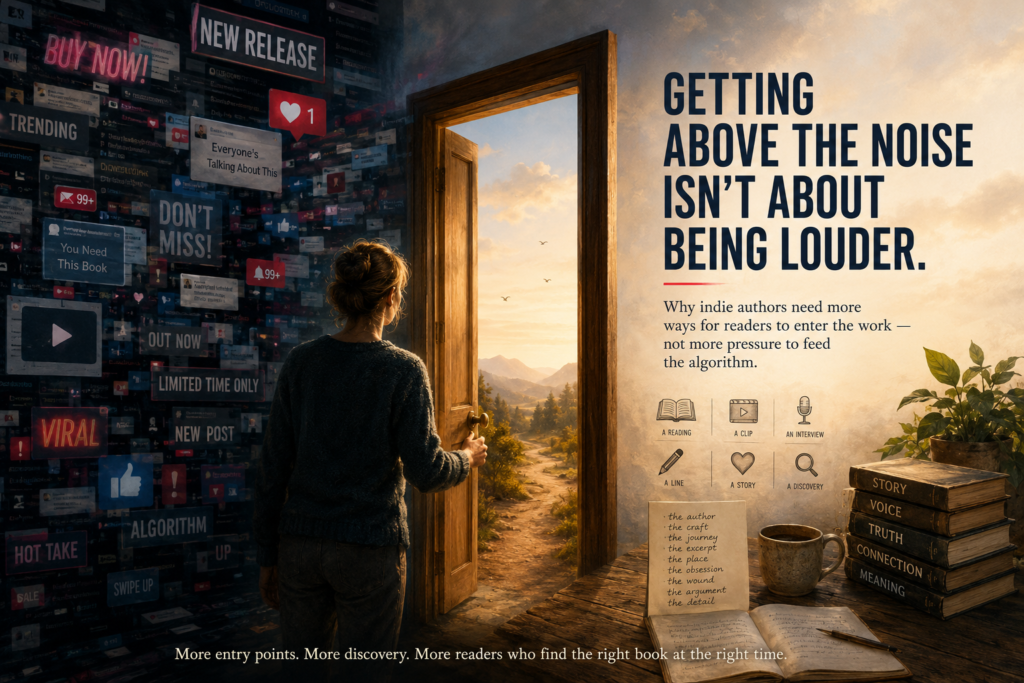
Why indie authors need more ways for readers to enter the work — not more pressure to feed the algorithm.
There is a phrase that gets tossed at writers as if it means something useful:
You need to get above the noise.
It sounds smart. It sounds strategic. It sounds like something someone says while pointing at a slide. But most of the time, it’s a lazy sentence dressed up as advice.
Above what noise? Whose noise? On what platform? For how long? And with what exactly — another reel, another launch graphic, another “my book is out now” post floating past people who are already being chased by every product, opinion, headline, outrage, and dancing dog the internet can throw at them?
Writers are told to get above the noise, but the instruction usually translates into one thing:
Make more noise.
Post more. Promote more. Perform more. Package your life into content. Turn your process into content. Turn your vulnerability into content. Turn your exhaustion into content, but preferably in a way that still looks upbeat and brand-safe.
That is not a strategy. That is a treadmill.
And it is especially brutal for writers because books are not built like most social content. A book is slow. A book asks for time. A book often depends on mood, memory, trust, curiosity, and timing. A reader does not always meet the right book the first time it passes in front of them.
Sometimes the first contact is the cover. Sometimes it is a sentence. Sometimes it is the author’s voice. Sometimes it is a backstory. Sometimes it is a friend saying, “No, really, this one.”
Discovery is rarely as clean as the marketing people pretend.
And here is the part that should make indie authors breathe a little easier, or at least stop blaming themselves for five minutes: the big publishers are fighting the same problem.
Simon & Schuster, Macmillan, HarperCollins — pick the house. They all need the same thing you need. They need readers to find books.
That does not mean indie authors and major publishers are operating on equal ground. They are not. The big houses have distribution, relationships, sales teams, advance copies, media access, bookstore placement, paid campaigns, imprint credibility, and a machine that can move a title through the system with real force.
Those advantages matter. But they do not create certainty.
Plenty of traditionally published books miss. Good books miss. Expensive books miss. Books with strong blurbs, serious editorial backing, beautiful covers, and real promotional support still slide past the audience they were meant to reach. The industry knows this. It just does not like to linger there. Because the next season is already coming.
The big houses do not have a magic answer. They have a larger engine. And engines burn fuel.
For an indie author, trying to mimic that machine is usually a fast way to lose your mind. You do not have the same staff, budget, placement, or volume. You also do not have to operate on the same timeline. That matters.
A book does not become irrelevant because its launch window closed. A story does not lose its value because the first round of posts went nowhere. A reader discovering a book two years later is not a consolation prize. That is still discovery.
Moby-Dick is the easy example, but it is still the right one. When Herman Melville published it in 1851, the book did not become the thunderclap we now pretend it was always destined to be. It sold modestly, confused plenty of readers, and eventually slipped out of print during the last years of Melville’s life.
The book did not change. The world around it did.
Decades later, critics and scholars returned to it, and readers found the force that had been sitting there all along. That does not mean every overlooked book is Moby-Dick. That would be ridiculous, and honestly, a little exhausting. But it does mean a book’s moment does not always arrive on schedule.
The problem is that most book marketing treats a title like it has one moment to live. Launch it. Post it. Push it. Hope something catches. Move on. That model is convenient for calendars. It is not always good for books.
The better question is not, “How do I get louder?”
How many real ways can someone enter this work?
A book is not one sales message. It has more doors than that.
There is the author. There is the craft. There is the journey. There is the excerpt. There is the argument under the plot. There is the place. There is the obsession. There is the wound. There is the strange detail that will mean nothing to one reader and everything to another.
That is where the work starts to breathe in public. Not when the author shouts “buy my book” for the fifteenth time with a different background.
This is where a lot of advice to writers falls apart. It tells them to build a platform, but not what that platform is supposed to hold. It tells them to create content, but not how to create entry points. It tells them to be authentic, but only in ways that fit the algorithm’s appetite for novelty and confession.
No wonder writers are tired. Most of them did not set out to become a one-person media department. They wanted to write the damn book.
Still, the world has changed. Readers are finding books through video, interviews, clips, newsletters, podcasts, search, social posts, bookstores, libraries, events, friend networks, and weird little internet rabbit holes that no marketing plan could fully predict. That is not going away.
So the work is not to pretend authors can ignore visibility. They cannot. The work is to stop confusing visibility with noise.
Noise is volume without direction. An entry point is different — it gives the right person a reason to care.
That might be a reading. It might be a short interview clip. It might be a line about why the book had to be written. It might be a craft insight that makes another writer lean in. It might be a personal story that tells the reader, “There is a human being behind this.”
None of that guarantees success. Nothing does. But it gives the book more than one chance to be found. And that may be the part worth taking seriously.
Getting above the noise is not about being louder.
It is about refusing to mistake the feed for the whole world.
Stay in the loop
New essays, author stories, and craft insights — straight to your inbox.