Stop Asking Authors to Become Influencers

Writers need visibility, but forcing every author to perform for the feed is not a book marketing strategy. Here’s how to build better entry points into the work.
There is a special kind of nonsense that happens when people tell writers to “build a platform.”
It sounds reasonable at first. Practical, even. You wrote a book. You want people to read it. People need to know you exist. Fine. Nobody is arguing with that.
But somewhere along the way, “build a platform” turned into something much uglier:
Become an influencer. Post constantly. Film yourself constantly. Share your process constantly. Be charming, vulnerable, consistent, searchable, clickable, quotable, attractive, grateful, available, and algorithmically convenient. Also, keep writing. Also, don’t complain. Also, make it look natural.
This is the part where a reasonable person might ask: when, exactly, is the author supposed to be an author?
Because writing a book is not a side errand. It is not something you squeeze in between content pillars and engagement tactics. It takes time, privacy, failure, boredom, obsession, revision, and long stretches where nothing looks interesting from the outside.
Not everything that matters is camera-ready.
And yet authors are increasingly being handed advice that treats visibility as if it were the same thing as performance. It is not.
- Visibility means the right people can find the work.
- Performance means the author has to keep feeding the machine so the machine remembers she exists.
Those are not the same thing.
The Platform Advice Got Lazy
Let’s be honest. “Build a platform” has become one of those phrases people use when they do not want to say anything more useful. It is broad enough to sound strategic and vague enough to avoid responsibility.
Build a platform where? For whom? With what kind of content? To what end? How often? What are we measuring? Are we building readers, followers, customers, community, or just a public record of exhaustion?
Authors are told they need a platform, but they are rarely given a real architecture for one. So they do what most people do when the instructions are unclear: they copy what they see.
They post book covers. They post launch graphics. They post “available now.” They post photos of coffee and notebooks. They post about writing when they should be writing. They post personal things because the algorithm rewards intimacy, then feel vaguely gross afterward because they did not actually want strangers weighing in on their nervous system.
And if it does not work, the answer is always the same: post more.
That is not a strategy. That is a machine asking for another quarter.
Writers Are Not Failed Influencers
This needs to be said plainly: most writers did not choose writing because they wanted to become on-camera personalities. Some are good at it. Some even enjoy it. Great. Let them run. But plenty of serious writers are awkward in public, private by nature, allergic to self-promotion, or simply uninterested in turning every thought into a shareable asset.
That does not make them bad marketers. It makes them writers.
The problem is not that authors need to become less private, less literary, less introverted, or more willing to dance for the feed. The problem is that the current marketing conversation has mistaken one form of visibility for the whole damn map.
Video can be useful. Social media can be useful. Newsletters can be useful. Interviews, readings, bookstores, libraries, podcasts, essays, author pages, reader groups, and local communities can all be useful. But none of them are magic if they are disconnected from the work. And none of them require the author to become a full-time influencer.
The Feed Is Not Built for Books
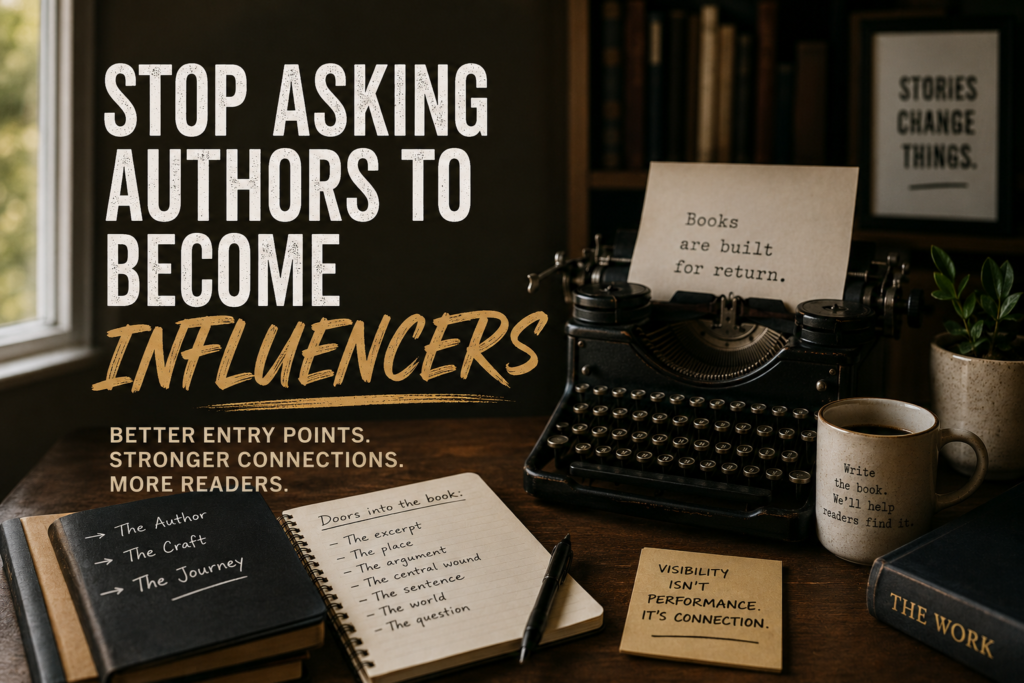
The feed is built for reaction. Books are built for return.
A social platform wants immediacy. A book often works by accumulation. A platform rewards the quick hit, the hot take, the clean confession, the repeatable format, the face, the hook, the thing that makes someone stop for six seconds before their thumb starts twitching again.
A book asks for a different kind of attention. It asks the reader to enter a world. To stay with a voice. To trust a sentence. To follow a question longer than the lifespan of a trending sound.
So when we tell authors to market books by behaving like influencers, we are often asking them to squeeze a slow medium through a fast machine and then blame themselves when the machine mangles the shape.
No wonder it feels awful. The book is trying to breathe. The feed is asking it to tap dance.
“Authenticity” Has Been Turned Into Labor
One of the more annoying tricks of modern marketing is the way it turns being a person into a job requirement. Be authentic. Show your face. Tell your story. Let readers in.
Fine. There is truth in that. Readers often do want to know the person behind the work. Context can create connection. But there is a line.
When authenticity becomes mandatory, it stops being authentic. It becomes another deliverable.
Now the author is not only responsible for writing the book, revising the book, publishing the book, promoting the book, building the audience, and tracking the numbers. She is also responsible for being emotionally available in public at a pace set by companies that profit from attention.
That is not connection. That is extraction with better fonts.
The Work Has More Doors Than the Author’s Face
Here is the part that gets missed. The author does not have to be the only doorway into the book. There are other doors.
- There is the excerpt.
- There is the place.
- There is the argument.
- There is the central wound.
- There is the world behind the story.
- There is the craft that shaped it.
- There is the strange research rabbit hole.
- There is the sentence that carries the whole thing in miniature.
- There is the object, the memory, the setting, the moral question, the moment when the story stopped being optional.
Those are entry points. They are not generic content. They are honest ways into the work. Instead of asking, “How do I make myself more entertaining?” the better question is:
What are the real doors into this book?
Not every door will work for every reader. That is fine. The point is not to become universally appealing. The point is to give the right reader more than one chance to recognize the work.
A Platform Should Hold Something
A platform is not a pile of posts. A platform is a structure. It should hold your point of view, your body of work, your reader pathways, your recurring themes, your public voice, your invitations, your archives, your conversations, and your ways of being found.
If all it does is demand that you show up and perform, it is not a platform. It is a treadmill with better branding.
For authors, a real platform might include a website that actually explains the work. A newsletter that lets readers stay close without begging an algorithm for permission. A few strong interviews. A reading. A page for each book. A clear way to buy. A way to contact you. A small but real social presence that points back to something you own.
It does not have to be huge. It does have to be intentional. Because:
- Followers are not the same as readers.
- Views are not the same as trust.
- Virality is not the same as a career.
The Better Ask
So maybe we stop asking authors to become influencers. Maybe we ask better questions:
- What does this author know that readers would care about?
- What does this book open that other books do not?
- What does the author’s journey reveal about the work?
- What part of the craft would be useful or fascinating to other writers?
- What scene, line, image, or question could pull a reader closer?
- What can be reused, shared, returned to, and built upon?
- What belongs on rented platforms, and what belongs somewhere the author actually controls?
Those questions lead somewhere. “Post more” does not.
Where to Start
Here is the first move. Choose one book. Not your whole career. Not your entire identity. One book. Then write down three things:
The Author
What should a reader understand about you in order to feel the human presence behind the work?
The Craft
What did the book teach you about writing, structure, research, discipline, failure, revision, or voice?
The Journey
What changed in you because you wrote it?
That is not a content gimmick. That is a map. From there, you can build a page, an interview, a reading, a few posts, a newsletter note, a short video, a bookstore pitch, a conversation starter, or whatever tool actually fits your temperament and audience.
The point is not to become louder. The point is to become easier to find without becoming less yourself.
Authors do need visibility. They do need readers. They do need to participate in how their work meets the world. But asking every writer to become an influencer is lazy, and frankly, a little insulting.
Writers are not failed content creators. They are people who built something the hard way.
Maybe we start there.
Stay in the loop
New essays, author stories, and craft insights — straight to your inbox.